
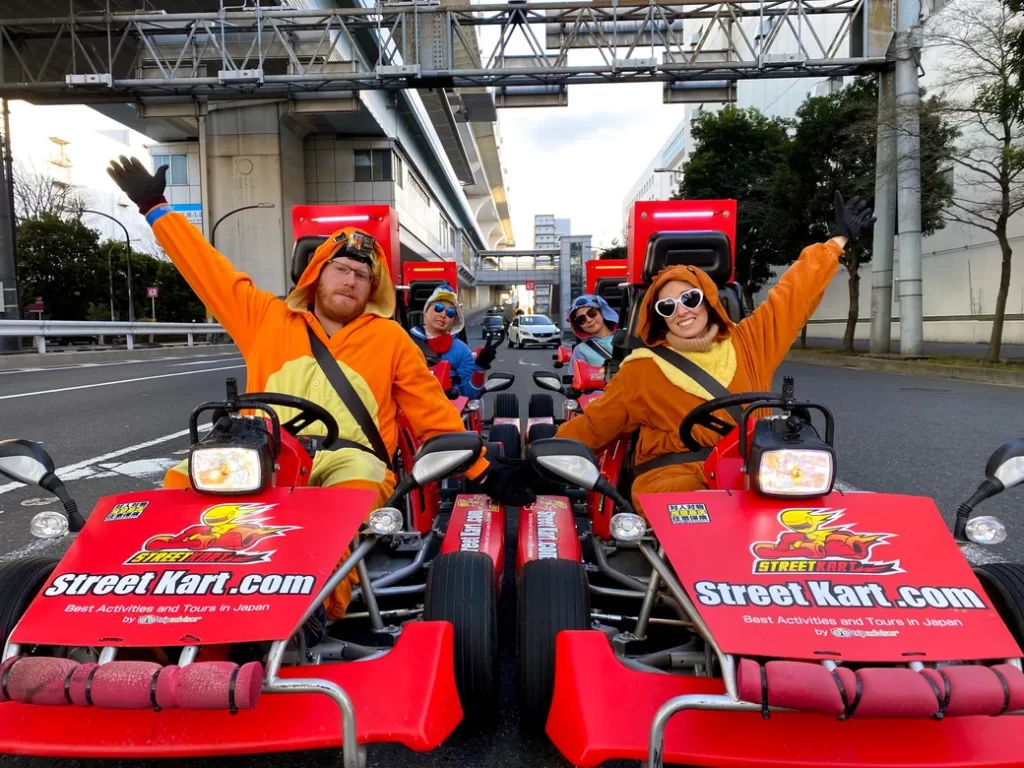
For Anyone Staying in Akihabara on a Business Trip: A Street Kart Experience Guide That’s Easy to Fit Into the Gaps in Your Workday
When you come to Akihabara for a business trip, your schedule tends to revolve around meetings and negotiations, and sometimes the whole itinerary ends up being nothing more than shuttling back and forth between your destinations and your hotel. At the same time, Akihabara has easy access toward Tokyo Station, and with plenty of restaurants and shopping facilities clustered nearby, it’s an area where you can map out how to spend even a short window of free time. For anyone who wants to soak up the atmosphere of the city even with limited time on their hands, a time-slotted, experience-based activity—on top of a stroll on foot—becomes an option worth considering.
One such option is a street kart experience that departs from and returns to Akihabara. The official site at [kart.st](https://kart.st/) lays out course information, participation requirements, and the booking path for departures from the Akihabara location. Because you drive on public roads, you get to feel the flow of the city from a different vantage point than you would touring sightseeing facilities. During a business trip, it can be hard to predict how much time you’ll have, but if you check the duration and meeting time in advance, it becomes easy to slot in before or after your work commitments.
Why Akihabara Is Easy to Get Around Even on a Short Stay
Because functions are concentrated around the station, Akihabara is a city where business travelers can easily plan their movements. If you’ve booked a hotel near the station, it’s easy to grab a bite or do some shopping on foot before or after a meeting, helping you keep travel-time losses to a minimum. Known as an electronics district, the area lines up not only stores selling home appliances and electronic parts but also cafés, restaurants, big-box retailers, and shops carrying daily necessities, so you can take care of small errands during your stay relatively all at once.
Akihabara also has plenty of character in its very streetscape. Large signs, the differing atmosphere from one street to the next, and the way the flow of people changes between weekdays and weekends, day and night—it’s an area where the city leaves an impression even in a short amount of time. On a business trip it’s hard to set aside half a day or a full day for sightseeing, but in Akihabara you can grasp the outline of the city in around an hour, making it easy to raise the density of your experience.
Even if your business contacts are scattered across central Tokyo, Akihabara tends to offer a relatively wide range of transfer options, so it can be easy to come back and carve out some free time. On days when your afternoon plans wrap up early, or when the next morning’s schedule starts a little late, the way you can make use of small pockets of spare time is genuinely practical for a business traveler.
A Way of Thinking About Making the Most of Free Time on a Business Trip
When it comes to how you act on a business trip, it’s not just about fun—predictability of time matters a great deal. When you can’t take long stretches of free time, choosing an experience with a clear start time and a clear sense of when it ends keeps your overall schedule from falling apart. A street kart experience falls into the category that’s easy to plan around on the premise of checking in advance, since the official site lists a course overview and information about meeting up.
Just walking around Akihabara on foot is plenty to take in the atmosphere, but if you want to physically feel the flow of the roads and the connections between city blocks—things that are hard to see on foot alone—a public-road activity becomes a chance to understand the city from a different angle. On business trips especially, you tend to move from point to point between destinations. Adding an experiential form of movement to that keeps your impression of the place from leaning entirely toward workspaces.
On the other hand, business travelers also need to be mindful of luggage and clothing. If you’re carrying a laptop and documents around, you’ll be lighter on your feet if you drop them at the hotel first, and if you have a dinner or meeting afterward, you’ll need to factor in a change of clothes and travel time too. Sorting out not just the experience itself but the flow before and after it actually ties directly to how satisfied you’ll be.
What Is a Street Kart Experience?
According to the information on [kart.st](https://kart.st/), Street Kart offers public-road kart tours at locations across Japan. The official site lists, in addition to multiple locations in Tokyo, guidance for stores in Osaka and Okinawa. In other words, it’s a service operated strictly within Japan, and it’s best understood as a travel experience for your time in the country.
The Akihabara page describes the “A1-S” course departing from the Akihabara location, with an estimated duration of about one hour. The course description introduces a flow that departs from the Akihabara store, passes through the Tokyo Station and Ginza areas, and returns to Akihabara. A time frame that’s neither too short nor too long is a factor that makes it relatively easy to fit even into a gap in a business trip.
The hallmark of this experience is that rather than viewing the city from inside its facilities, you feel the surrounding scenery continuously as you drive on public roads. The area around Akihabara has a strongly commercial streetscape, but as the course spreads out into central Tokyo, it becomes easier to see Tokyo’s different faces in one continuous stretch. The appeal of this kind of experience is that you can take in the sense of scale of the city—something you tend to let slip by when moving on foot or by taxi—in a different form.
Also, because it’s operated as a guided tour, participants don’t drive freely on their own but proceed along the guidance provided. For someone visiting Tokyo for the first time on business, or for someone not yet used to Japan’s traffic environment, a format with advance briefing and progress management is likely easier to plan around than navigating the city solely through personal arrangements.
Considering the Highlights of the Akihabara Course From a Business Traveler’s Perspective
Rather than simply listing tourist landmarks, the course departing from Akihabara is characterized by how easy it makes it to feel the shifts in Tokyo’s urban landscape in a short time. The streets around Akihabara’s electronics district are full of visual information, but as you move from there toward the Tokyo Station area, the way the city’s lines are drawn and the way buildings appear both change. Head further toward Ginza, and the atmosphere of the roads and the impression of the roadside differ again. Being able to physically take in these changes in around an hour leads to an efficient understanding of the city for a business traveler.
On foot, you tend to spend a long time within a single block, but on a driving tour you can take in the differences between multiple areas in succession. This is a quality well suited to business travelers who find it hard to set aside enough time for sightseeing. Rather than carving things up into “just Akihabara” or “just Tokyo Station” within a short window of free time, it becomes easier to grasp several faces of central Tokyo all at once.
Also, when you’re staying in Akihabara, your day inevitably tends to wrap up within just the commercial facilities around the station and the area near your hotel. Inserting a street kart experience adds an impression of the city that’s hard to retain from merely shuttling between hotel and meeting room. This is less about ramping up the tourist flavor and more akin to leaving the concrete texture of a place in your memory of the trip.
License and Required Documents to Check Before Participating
The first thing you should check when considering a street kart experience is the license requirements. The [driver's license guide page](https://kart.st/en/drivers-license/) explains the documents required to drive in Japan. Since the required documents differ depending on the participant’s license category, the official site asks that you confirm the guidance that matches your own situation before booking.
The guidance on the Akihabara page also indicates that to drive, you need a valid Japanese driver’s license, an International Driving Permit, a license for U.S. military personnel stationed in Japan, or—depending on the applicable person—your home-country license together with a Japanese translation document. It further states clearly that if you don’t have the required original documents in hand, you cannot participate, and you will not be eligible for a refund. Because business trips involve a lot of moving around and you might end up tucking your documents into a different bag, it’s practically important to confirm where your originals are by the day before.
What deserves particular attention is that not only the “type” of document but the “original” is required. It’s risky to assume an image or copy on your smartphone can serve as a substitute. Before proceeding with a booking, checking the official driver’s license guide page and sorting out what you need for your own case helps you avoid trouble on the day.
Practical Information Worth Reviewing Before and After Booking
The official site lists business hours, locations, access, and the path to the booking page for each store, including the Akihabara location. The guidance for the Akihabara #1 store gives access information of a 7-minute walk from the Electric Town Exit of JR Akihabara Station and a 3-minute walk from Exit 1 of Suehirocho Station. Since you sometimes move by the minute on a business trip, knowing the sense of distance from the station in advance is practical.
The official guidance also describes a flow such as arriving “up to 30 minutes before your reserved time” as the meeting time. If there’s a chance your meeting could run long, you’ll need to adjust your surrounding plans using this meeting time as a benchmark. Slotting an important negotiation or a long-distance trip right after it ends can leave you without any breathing room, so allowing a buffer of about 30 minutes to an hour after the experience makes planning easier.
As for cancellations and changes, the official site states that reservations can be changed depending on availability, and that the cancellation policy applies from 6 days before the date of use onward. Since business trips are prone to schedule changes, this kind of condition is a point you should check before booking. Even when it looks flexible, last-minute changes may be subject to restrictions.
Clothing, Luggage, and How to Move on the Day
For a business traveler to realistically fit in the experience, designing the day’s flow is essential. If you’re staying in Akihabara, it’s easy to set up a flow where, after finishing work, you return to the hotel once, drop off any unnecessary luggage, and then head out. Carrying a laptop, charger, documents, and a business card holder around lowers your freedom of movement. Just paring down to the bare minimum of belongings lightens the load.
As for clothing, the official site advises avoiding heels, sandals, and long skirts. Many people move around in dress shoes and suits during a business trip, but if you’re thinking of participating, it’s more practical to consider switching to clothing that’s easy to move in, depending on your plans for the day. If you’re heading straight to a dinner after the experience, you’ll need to build in the time to return to the hotel as well.
Since the area around Akihabara has many dining options, it’s also an area where it’s easy to plan a meal before or after the experience. Grabbing a light bite before the start, meeting up with colleagues afterward, or having a quick solo dinner before heading back to the hotel—the ease of adjusting to your schedule is another point that suits business travelers.
How to Position the Value of the Experience Within an Akihabara Business Trip
On a business trip, free time tends to be treated as “leftover time.” But inserting an activity that lets you touch the character of a place, even briefly, can change the impression of your whole stay considerably. Akihabara functions well both as a base for work and as a starting point for a short experience. Within that, street kart can be called an option suited to anyone who wants to take in Tokyo’s urban sensibility in a way that differs from sightseeing on foot or shopping.
What matters is not to exaggerate it as some overly special experience, but to grasp it as a public-road tour that’s relatively easy to fit into the limited free time of a business trip. The Akihabara-departing course runs about an hour, the meeting time is early, and participation is premised on confirming the required documents—sorting out the conditions like this makes it easier to weigh your decision.
If you feel it would be a bit of a shame for your stay in Akihabara to end as nothing but memories of meeting rooms and the hotel, it’s worth slotting in a block of time to see the city from a different perspective. For details and bookings, refer to the official site at [kart.st](https://kart.st/), and for license requirements, see [https://kart.st/en/drivers-license/](https://kart.st/en/drivers-license/). If you check the official information in advance and then work it into your schedule, it becomes easy to consider even in the gaps of a business trip without overextending yourself.
We do not offer rentals of costumes related to “Mario Kart” or other Nintendo works. For details on costumes, please check the Street Kart official site.

