
A Second Akihabara Street Kart Ride with a Coworker: The Sights You Missed the First Time, and How to Plan the Time Before and After
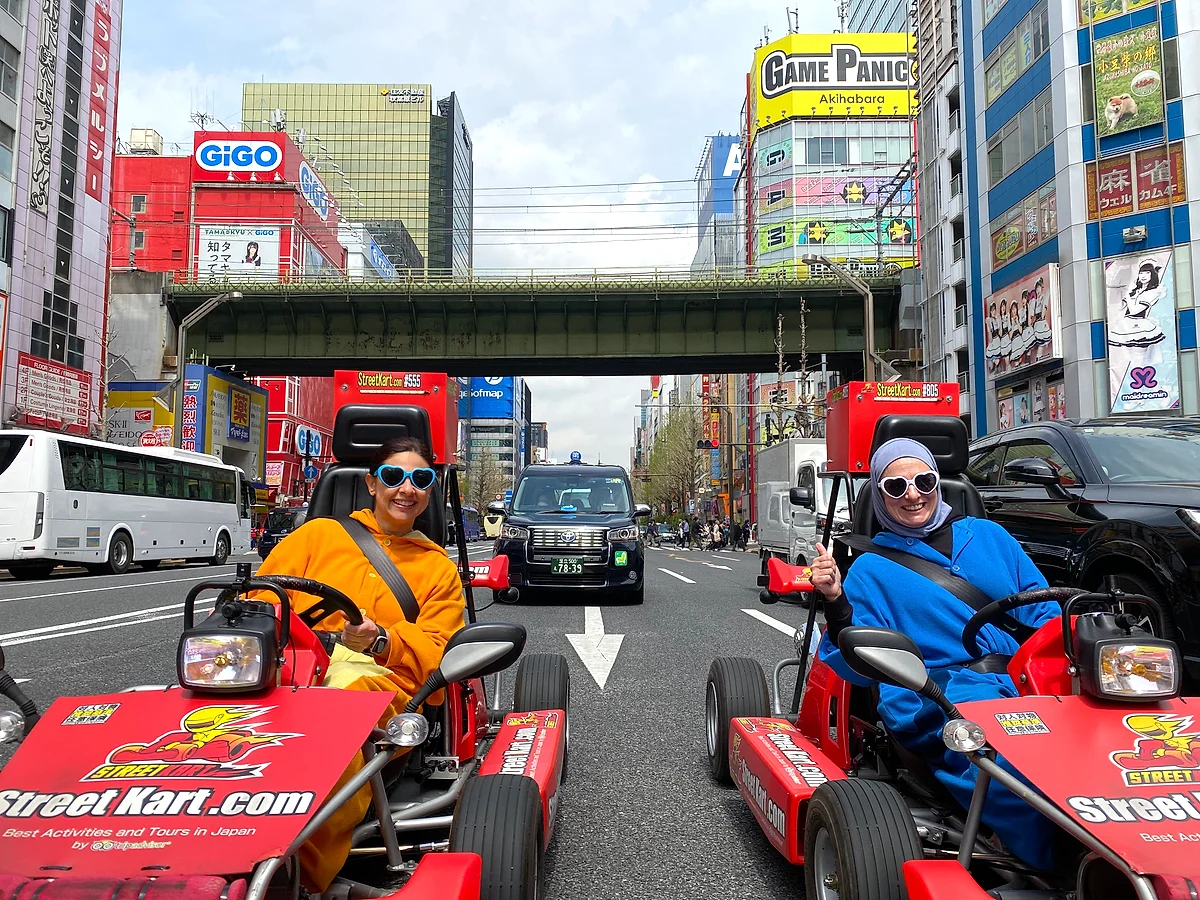
A Second Akihabara Street Kart Ride with a Coworker: The Sights You Missed the First Time, and How to Plan the Time Before and After
Think back to your first time for a moment. You followed the guide, watched the traffic lights, and tensed up every time a taxi pulled alongside you in the next lane. Before you knew it, Tokyo Station's red brick had slipped past behind you, and you thought, "I didn't really get a good look at that." Some of you probably remember it that way.
The second ride is your chance to go back for the sights you missed. The first time, operating the kart takes all your attention. The second time, the steering wheel feels a little more familiar, so you have room to look up. This article is about riding Street Kart in Akihabara again, this time with a coworker who's in Tokyo for a business trip or vacation. It covers three things, in this order: what to look at during the tour, how to use the time before and after, and where to take photos.
The Second Time, You Stop "Driving" and Start "Reading the City"
I don't think driving skill is the biggest change on a second ride. The biggest change is the spare attention you have.
The first time, listening to the pre-departure briefing, fitting yourself into the kart, and keeping up with the guide took everything I had. That's perfectly fine. By the second time, your body mostly remembers how departure works and how to stop at a light. That frees up an empty shelf in your head, and you can fill it with scenery.
One thing to keep in mind: Street Kart is a guided tour. The guide manages the route, so you don't pick where to go. That means the fun of a second ride isn't about where you go. It's about what you notice on the same roads, and the same roads can look very different the second time.
Check the details, like how groups are put together and whether just the two of you can ride alone, on the Street Kart official website before you book. If you catch the eye of a traveler you've never met at a red light and you both burst out laughing, a second ride gives you the room to actually enjoy that moment.
When coworkers go out together, the mood can easily turn into "faster than last time" or "who drives better." Don't go there. This is a tour where you follow the guide and obey the traffic rules, so there's nothing to compete over. Make your goal for the second ride "see more than last time." Agree on that before you set off, and your conversation afterward will be much more interesting.
Sights to Look For on the Akihabara Route the Second Time
The Akihabara location has a 1st Store and a 2nd Store, and they're almost in the same place. Landmarks listed for the route include Akihabara Electric Town, the Marunouchi building of Tokyo Station, and the streets of Ginza. The exact route varies by tour, so check the Street Kart official website if you want to know more. Below I'll describe how to take a second look at the sights that just "flowed past" the first time.
Between Electric Town's Layers of Signs and Ginza's Clock Tower
Chuo-dori in Akihabara Electric Town is a street where signs pile up higher and higher. On your first ride, the flood of information may have left you remembering little more than "it was flashy." This time, look at how high the signs go. There are storefronts at street level, big ads halfway up the buildings, and signs near the rooftops, stacked in tier after tier. That stacking is what makes Akihabara feel so dense.
As you head toward Ginza, the city changes its face. The signs get quieter, and department stores and long-established buildings line up their calm facades. There's the Wako clock tower at the Ginza 4-chome intersection, Ginza Mitsukoshi, Matsuya Ginza, and, a little farther off, the Kabukiza theater. Ginza has been a shopping and entertainment district since the Meiji era.
Akihabara's noise gives way to Ginza's calm, and that seam is my favorite part of the route. Even if you missed it the first time, pay attention this time to where the atmosphere shifts, and you'll start to see where one neighborhood ends and the next begins. Afterward, ask your coworker, "Where did you think it changed?" You'll be surprised how often you disagree, and that's half the fun.
Taking In the Details of Tokyo Station's Red Brick
The Marunouchi building of Tokyo Station is a red-brick station building that opened in 1914 (Taisho 3), and its restoration was completed in 2012. It's built in a style known as Tatsuno-style free classic, and it's designated an Important Cultural Property.
On a first ride, it tends to register as just "a big red building." This time, notice how the red brick pairs with the white bands, and how far the building stretches out to the left and right. The domed roofs at either end of the front are worth a look too. You can't study it closely while driving, so make a mental note of what catches your eye and walk back to see it after the tour. Notice it from the kart, then confirm it on foot. That back-and-forth is probably the best way to enjoy a second ride.
Going with a Coworker: How to Plan Around the Tour
Whether you're squeezing this into a business trip or fitting it into a vacation, your time is limited. Tour length depends on the plan, so check the official website. Here I'll lay out how to plan the time before and after, along with rough distances around the Akihabara store.
Before the tour, keep things light. Starbucks Akihabara Ekimae is about a two-minute walk away, which is the perfect distance for the two of you to talk about what you want to look at before meeting up. To get to the store, it's about a 5, 7 minute walk from JR Akihabara Station, or about 3 minutes from Suehirocho Station on the Tokyo Metro Ginza Line. The store has no parking, so take public transportation. Type the station name into Google Maps and trace the route from the ticket gate once ahead of time, and you won't be scrambling on the day.
The time after the tour is where the second ride really pays off. Kanda Myojin, about a 10-minute walk away, is a shrine said to have 1,300 years of history as the guardian shrine of old Edo, and it's known for blessings for business prosperity. If you're there with a coworker, it's not a bad place to go. After soaking up the city's energy from the kart, step into the shrine grounds and you'll feel the engine noise still ringing in your ears quietly fade.
If you can go a bit farther, Tokyo Station is about a 20-minute walk or about 5 minutes by train. You'll get to stand in front of the Marunouchi building on foot, the same building you only caught out of the corner of your eye from the kart. Ginza is about 10 minutes by train, and you can stand at the intersection and look up at the Wako clock tower.
The "Debrief" Starts with the Karts
In the U.S., getting together with coworkers outside the office probably means grabbing a drink at happy hour after work. Japan has its own version called nomikai, where people from work go out for food and drinks after hours. But ending up at the usual place talking about the usual things probably happens in every country.
A meal after Street Kart never runs short of things to talk about. Everyone drives their own kart, so there's no chance to chat with the person next to you while you're driving. That means once you're off, you each bring back what you saw. "Did you see that intersection?" "It got quiet all of a sudden when we hit Ginza, didn't it?"
Tonkatsu Marugo, about a 10-minute walk from the store, or Kanda Yabu Soba, a long-established soba restaurant about 15 minutes away, are exactly the kind of places that suit a debrief like this. Once you're seated, try saying "Otsukaresama desu" to your coworker. In Japanese workplaces it's a handy phrase that works both as a greeting and as a "thanks for your hard work."
Take Your Photos After You Get Out of the Kart
I'll be clear about photos: don't pull out your smartphone to take pictures while driving. You're on public roads, so your hands and eyes are needed for driving.
You'll still have plenty of time for photos before and after the tour.
On a second ride, I recommend taking what I call "answer-check photos": walk back afterward and shoot the sights you noted during the tour. On Chuo-dori in Akihabara Electric Town, step back a bit and capture the signs stacked on top of each other. The density you felt while driving comes through in the photo. At Tokyo Station, the front facade on the Marunouchi side is the classic photo spot. To fit the long, wide building into a single frame, you'll have to back up quite a way. If you capture that "can't quite fit it in" feeling, the photo will match the impression you had from the kart.
When taking photos at the shrine, be considerate of people who are there to pray. If someone might end up in your shot, ask "Shashin o tottemo ii desu ka?" ("May I take a photo?"). That one question makes things a lot more comfortable for you as the photographer, too.
With two of you, you can take turns photographing each other. When you travel alone, you rarely end up with photos of yourself, so that's a small perk of coming as a pair. If you post on social media, one option is to mix English and Japanese hashtags, like #Akihabara #TokyoStation #秋葉原.
Why People Choose Street Kart
Let me sum up what makes Street Kart stand out. Even if you've ridden once before, putting it into words should give you a clearer sense of what to enjoy the second time.
First, there's how the kart itself feels. The wind on your face, the sounds of the intersections, the fine vibration of the engine coming up through your feet. The ground feels close, and the buildings you look up at seem a different height than they do when you're walking. On the second ride, you can take in, one by one, the sensations that were too much to absorb the first time.
Next is its track record. As of November 2023, across all locations, Street Kart had run over 150,000 tours, served over 1.34 million customers, and received over 20,000 reviews, with an average rating of 4.9 out of 5. These figures are not current.
Third is the lineup of locations in Tokyo. Street Kart has 9 locations nationwide (7 in Tokyo, 1 in Osaka, 1 in Okinawa). Of the 7 Tokyo locations, the Akihabara 1st and 2nd Stores are almost in the same place, and so are the Shibuya store and Shibuya ANNEX, so they aren't spread across 7 separate areas. Beyond Akihabara, there are locations in Shibuya, Shinagawa, and Tokyo Bay (Shinkiba), each with its own feel. If your last ride was somewhere other than Akihabara, a different side of Tokyo is waiting for you this time: Tokyo Station and Ginza. If your last ride was also in Akihabara, this time you can focus entirely on collecting the sights you missed.
What to Check Together Before You Book
On a second visit, it's tempting to skip the prep because "it'll be the same as last time." In my experience, that's usually why people end up scrambling on the day after inviting a coworker along on a business trip.
First, driver's licenses. Just because you could ride last time doesn't mean the same license will work this time. You might have brought a different license than before, or your coworker might be riding for the first time. Each of you should check the required license and what to bring for your own license on the official driver's license page.
Second, timing. Weekends fill up quickly, so once your schedules are set, it's best to book early. If you're fitting this into a business trip, consider weekdays too and compare them with both of your schedules.
Third, how to book. Check where to book on the Street Kart official website, and have one person handle all the communication for the two of you. It keeps things simpler.
Fourth, which store you booked. The Akihabara 1st and 2nd Stores are almost in the same place, but share your booking confirmation with each other so you don't mix up the meeting point.
Fifth, the language of the tour. Guidance on the day is basically in English. Guidance in Japanese or other languages depends on the staff working that day and can't be promised. The website is available in 22 languages, but that only applies to the website, not to the language used on the tour itself. If you have any concerns about language, check the official website before booking.
Why Drive the Same Roads Again
A second Street Kart ride isn't just a continuation of the first. The stacked signs of Electric Town, the shift in the air as you enter Ginza, the red brick of Tokyo Station: things you simply passed by the first time, you can now put names to.
That's even more true with a coworker. While you're driving, each of you sees your own version of the city. Once you're off, you walk to Kanda Myojin, then sit down over tonkatsu or soba and compare notes: "Where did the air change?" Conversations that would never come up in a meeting room will probably start right there.
Once your dates are set, talk with your coworker about whether you can avoid the weekend, and book early. You can check tour details on the Street Kart official website.
The sights you missed last time are still out there on the streets of Akihabara.
This article was originally written in Japanese and translated using AI. Some expressions may read unnaturally, and we appreciate your understanding. For the most accurate and up-to-date information, please refer to the official site at kart.st.
Street Kart is not affiliated with Nintendo or the Mario Kart series in any way. We do not provide costumes of Nintendo characters, and such costumes may not be worn during tours even if brought by participants.