
Bustling Station Front, Quiet Back Alleys in Akihabara: Common Pitfalls for Two Travelers and How to Avoid Them
Busy Station Front, Quiet Back Alleys in Akihabara: Common Pitfalls for Two Travelers and How to Avoid Them
Step through the ticket gate at the Electric Town Exit, and the first thing that hits you is the sound. Music blares from shopfront speakers, staff call out to passersby, and people chat while they wait for the light to change. Step one street in from Chuo-dori, though, and it all fades. A warehouse sits with its shutters down, and a few bicycles lean against the edge of a narrow lane. Some moments, the only thing you can hear is the low hum of air-conditioning units.
In Akihabara, these two sides of the city sit just a few minutes' walk apart. And when you travel as a pair, the places where things go wrong tend to be the same. You lose each other in front of the station. You stop at so many shops that you run out of time. You get so caught up taking photos in the alleys that you stop noticing what's around you. This article is for couples and pairs who want to see both the crowds and the quiet. It goes through the common mistakes one by one and how to avoid them. Later on, it also covers what to keep in mind if you add a Street Kart tour starting from an Akihabara location to your itinerary.
Why pairs get separated right outside the Electric Town Exit
Akihabara Station is served by JR, the Tokyo Metro Hibiya Line, and the Tsukuba Express, and it has more than one exit. If all you agree on is "let's meet at the station," one of you may end up waiting at the Electric Town Exit while the other waits at a different one. You both text "I'm at the station," and you still can't find each other, because you're in two different spots at the same station.
The fix is simple: agree on the exact exit name. If you came to see Akihabara's buzz, the Electric Town Exit (Denki-gai Exit) is the easiest choice. Search for "Akihabara Station Electric Town Exit" in Google Maps and share the pin, so you can check the map if either of you gets lost. Also save the exit name in your phone's notes, so you aren't depending on your battery or an app working properly.
One more thing to decide in advance is what to do if you lose contact. A dead battery, a weak signal, a missed notification: if you've simply agreed to "go back to the last exit we picked and wait there," you'll both head for the same place.
Another trap is stopping right outside the ticket gate. Foot traffic in front of the station moves fast, and if you pull out a map there, the people behind you get stuck. If you need to rethink where you're going, move next to a pillar or over to a building wall first. That small step makes things much easier for you and for everyone around you.
One street off Chuo-dori, the sounds change
Akihabara's Electric Town is packed with stores such as Yodobashi Camera, Radio Kaikan, Sofmap, and Animate. Signs stack higher and higher up the buildings, merchandise is piled outside the shops, and people handing out flyers call out to you on the sidewalk. Honestly, the thing to watch here is time. You step into a building "just to take a quick look," and before you know it you've climbed several floors. That happens all the time in Akihabara.
When there are two of you, the problem doubles. One of you drifts toward the electronics floor while the other is pulled toward the anime merchandise shelves. Neither is wrong. But if you only have limited time and still want to see the quiet back streets, it helps to set some ground rules first. Each of you picks one must-visit shop, and you set a phone alarm to mark the time limit. When it goes off, leave Chuo-dori and move one street inward.
The same goes for splitting up across floors in a big building. Decide in advance where to meet, for example, "When the alarm goes off, meet at the first-floor entrance." That's much faster than searching for each other on the upper floors.
Once you step into the back streets, the atmosphere clearly shifts. The sidewalks narrow, the buildings get a bit lower, and there are fewer signs. A delivery truck is parked, and the door of a small office stands open. This is less a tourist spot than the working side of the city.
A common mistake here is for two people to stop side by side in the middle of a narrow street. Bicycles and hand carts coming from behind can't get through. In the alleys, walk single file, and step to one side when you stop. These lanes, called roji in Japanese, are everyday streets for the people who live and work here. If you want to enjoy the quiet, it helps to walk as though you were part of it yourselves.
The moment you come back out of the alleys onto Chuo-dori is another fun part of this neighborhood. Turn one corner and the music and voices rush back at you. After the quiet, the same street you walked earlier will probably sound even louder.
Photos call for different approaches at the station front and in the alleys
On Chuo-dori, wide compositions that capture the stacked signs work well. Move to the edge of the sidewalk, have one person stand in the foreground, and fill the background with Electric Town signs. Shooting vertically really brings out the way the signs pile up toward the sky. The signs start to stand out once it gets dark, but sunset times vary a lot by season. Check the day's sunset time in a weather app before you plan your day, and scheduling gets easier.
In the alleys, do the opposite and frame tightly. The color of a closed shutter, the lettering on an old sign left on a wall, the handlebars of a row of bicycles. Put one of these next to a shot from the station front, and the pair will hardly look like the same Akihabara.
Take care when photographing people or the inside of shops. If you want a picture of a storefront or a staff member, ask first. "Shashin o totte mo ii desu ka?" (May I take a photo?) is enough to get the message across. If they say no, simply let it go. In the alleys, the windows and doorways of people's homes easily end up in the frame, so be a little mindful of where you point your lens, too.
One more thing: don't take photos while you're on a crosswalk. Stopping as the light changes puts you and the people around you at risk. If you spot a view you want to capture, finish crossing, then set up your shot again from the edge of the sidewalk.
If you're adding karting to your plans, the trip there is the usual problem
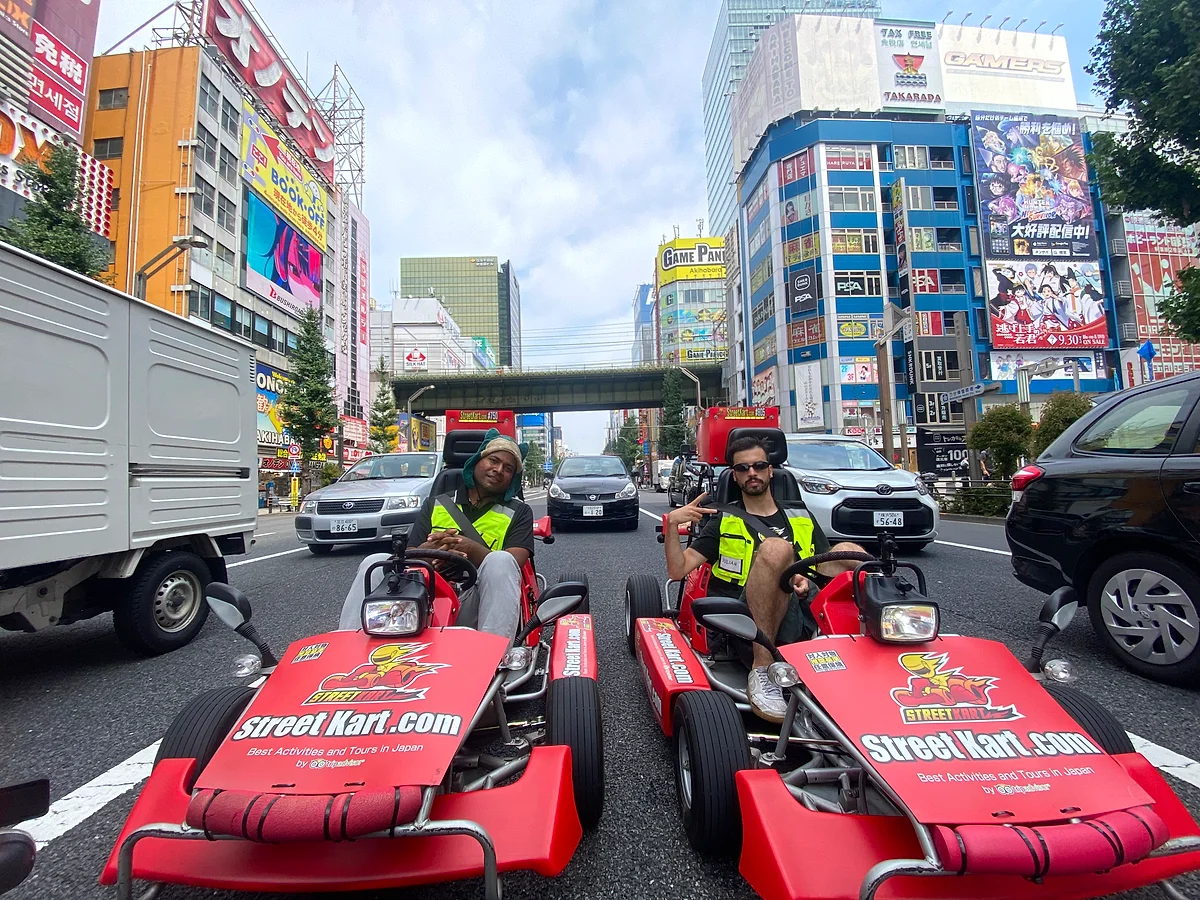
Street Kart has locations in Akihabara, and you can join guided tours that depart from them. There are two Akihabara locations, Store 1 and Store 2, but they're very close to each other. When you book, check which location you'll be checking in at.
On the day, avoid coming by car. The stores have no parking, and they recommend using public transportation. By train, Store 1 is a 5-minute walk from JR Akihabara Station and a 3-minute walk from Suehirocho Station on the Tokyo Metro Ginza Line. Store 2 is a 7-minute walk from JR Akihabara Station. Iwamotocho Station on the Toei Shinjuku Line is another nearby station for this area. As mentioned earlier, though, Chuo-dori is full of shops that tempt you to stop. Skip the browsing before check-in and head straight there to be safe.
One timing tip as well: there's a check-in and safety briefing before the tour, so plan to arrive at the store at least 15 minutes before departure.
Watch your luggage, too. After shopping in Electric Town, the bags tend to pile up. The stores have lockers for small items, but they aren't suited to large luggage like suitcases. Saving your shopping for after the tour lets you travel light. For footwear, closed-toe sneakers are recommended.
Book early. Weekends fill up quickly, so if you want to ride on a weekend, it's best to get in touch as soon as your plans are set. Reservations are accepted via Facebook, LINE, and email, and contact details are all listed on the Street Kart official website. Prices vary by season and time slot, so check the latest rates on the official website (kart.st) as well.
Weather can affect your plans too. In light to moderate rain, tours go ahead as scheduled and raincoats are provided free of charge. In heavy rain or typhoons, tours are canceled, and you can choose between a shortened tour, rescheduling, or a full refund. If rain is in the forecast, leave yourselves room to move to another day so neither of you has to scramble.
And one thing people tend to forget: driving licenses. Which licenses allow you to drive depends on your country and your documents. Check the latest requirements on the official website before your trip. If only one of you has the right documents, that's almost impossible to fix once you're traveling. To be sure, show each other your documents before you leave home.
Akihabara from a kart vs. Akihabara on foot
One thing should be clear up front. Street Kart is a guided tour, and each tour follows a set route. It isn't a vehicle for wandering down any alley that catches your eye. If you come expecting to "cruise Akihabara's back streets by kart," the experience won't match what you had in mind.
That's why it makes sense to give each part of the day its own role. Your time in the kart is for taking in the big picture of the city. Routes from the Akihabara locations include Electric Town's Chuo-dori and, depending on the course, the red-brick Marunouchi Building of Tokyo Station and Ginza, home to the Wako building with its clock tower. From the signs of Electric Town, to the heavy brick of a station building that opened in 1914, to Ginza's streets lined with department stores, you'll watch the character of the city change along a single route. If you're curious about exactly where you'll go, ask when you book.
Save the quiet of the alleys for your time on foot. What you notice from a kart and what you notice walking are simply different things. Fitting both into one day makes the contrast all the clearer.
The same goes for photos. While driving, don't touch your phone, and keep your focus on the steering wheel and the road ahead. Take pictures around the store before you ride, or in the alleys you walk afterward. With two of you, you can also split the work: one takes photos while the other keeps an eye on the surroundings.
What makes Street Kart worth it
First, a guide leads the way. On Street Kart tours, a trained guide drives at the front. You don't have to find your way around an unfamiliar city with your hands on the wheel. You still follow Japanese traffic rules, of course. Even so, not having to think about directions makes a real difference to how relaxed you feel.
Tours are generally guided in English. Guidance in Japanese or other languages depends on the staff working that day and isn't guaranteed. If you'd like a language other than English, contact them through the official website in advance.
Because the route is set, nobody has to be the map reader. When traveling, one person almost always ends up navigating, but for this stretch of time you can both just watch the scenery ahead. That's a pretty nice way to spend part of a trip.
Then there's the feel of the kart itself. Once you get moving, the sounds and wind of the city feel remarkably close. The buildings you usually look up at may seem a different height from down there.
Starting from Akihabara, depending on the course, you'll link together neighborhoods with completely different characters, from Electric Town to Marunouchi and Ginza, along a single road. It's a chance to see this article's theme of "contrast" from a different angle than you get on foot.
A few numbers, too. As of November 2023, the average rating was 4.9 out of 5, with more than 20,000 reviews. There are nine locations across Japan, seven of them in Tokyo.
If you want to check details before booking, the website is available in 22 languages.
Before or after the tour, walk to Kanda Myojin for some quiet
After you get out of the kart, you may both be a little tired. A common mistake at this point is cramming too much into the time you have left. Another lap of Electric Town, then dinner, then a stop in Ueno too... Get greedy, and you end up rushing through all of it.
About a 10-minute walk from the area where the stores are is Kanda Myojin, a shrine with 1,300 years of history, known as the guardian shrine of all of Edo. As you walk away with the sounds of Electric Town behind you, by the time you reach the shrine grounds, the noise from a little while ago will probably feel far away. Placing just one quiet spot after the crowds changes the whole impression of your day.
Once you're inside the grounds, try lowering your voices a little when you talk. Partly it's so you don't disturb people who are praying, but it also makes the contrast with Electric Town, where you were just a short while ago, even sharper.
For a meal, options include Kanda Yabu Soba (a long-established soba restaurant), about a 15-minute walk away, or Tonkatsu Marugo, about a 10-minute walk away. If you'd rather rest somewhere greener, Ueno Park is about 5 minutes away by train. Still, one of these is plenty. Agreeing together that "this is where we stop today" will leave you with enough energy for the rest of your trip.
One small practical note: there are convenience stores near the stores, and you can use their ATMs. If you end up at a cash-only place, you can withdraw money there.
Taking home both sides of Akihabara when time is short
The crowds in front of the station, and the quiet of the alleys. You don't need any special preparation to see both in Akihabara. Agree on the exact exit name when you meet up. Use an alarm to limit your shopping detours. Walk single file in the alleys. Treat the kart as time to see the city's big picture, and the alleys as time to notice small things on foot. Most of the common stumbling points can be avoided with just a short talk between the two of you before you set out.
If you're adding karting to your itinerary, start by checking the license requirements and the booking contacts. If you're aiming for a weekend, act early. Once you're ready, head to the official website.
Under the signs of Chuo-dori, and along the quiet street one block behind. Go see these two faces of the same city side by side, together.
This article was originally written in Japanese and translated using AI. Some expressions may read unnaturally, and we appreciate your understanding. For the most accurate and up-to-date information, please refer to the official site at kart.st.
Street Kart is not affiliated with Nintendo or the Mario Kart series in any way. We do not provide costumes of Nintendo characters, and such costumes may not be worn during tours even if brought by participants.