
Akihabara Looks Different at Different Times of Day When the Wind Is Strong: Tips for Two Travelers and Street Kart
Akihabara Looks Different at Different Times of Day When the Wind Is Strong: Tips for Two Travelers and Street Kart
You open your weather app and see a row of wind icons. The two of you came all the way to Tokyo, so should you really cancel everything planned for today? If you're stuck on that question in the morning, try a slightly different plan for your day in Akihabara.
Akihabara's big buildings and indoor shops are packed in close around the station. Even when the wind picks up, you're never more than a few minutes' walk from a door. And even on the same windy day, morning, midday, and evening each call for different precautions and give you different photos. This article walks through how to spend the day in Akihabara by time of day, and then how to think about fitting Street Kart into your plans.
Decide This First: Go by What the Town Looks Like, Not the Clock
I won't split the day into "from this hour to that hour." Sunrise and sunset shift a lot with the seasons, and the windiest hours change from day to day. Japan also has no daylight saving time. If you're coming from the US or Europe, it may surprise you how early summer evenings get dark.
So the day is split by what the town looks like. "Morning" is when shop shutters are still down and few people are out. "Midday" is when the shops open and the crowds grow. "Evening into night" is when the signs start to light up. Those are the three. Match them to actual hours based on the season you're traveling in.
One more thing: how to read wind numbers. Japanese weather forecasts give wind speed in "m/s" (meters per second). 1 m/s is about 2.2 mph, so if you think in miles, just double the number and add a bit. Besides average wind speed, forecasts sometimes list the "maximum gust." When a sudden push of wind catches you while walking, it's usually a gust. The Japan Meteorological Agency website has English pages. A quick look the night before makes it easier to plan the next day.
Morning: Learn Where the Wind Blows in a Quiet Electric Town
In the morning, Akihabara looks like a different town than it does at midday. Leave through the Electric Town exit and head toward Chuo-dori, and most shops are still behind their shutters. All you see are delivery trucks and the backs of commuters hurrying to work. The signs are already loud and colorful, but the sidewalks are nearly empty. You only get to see that mismatch before the shops open.
On a windy day, the morning is a good time to scout your route. Chuo-dori is wide, and the wind runs straight down it. Turn the corner of a big building and it may suddenly hit you hard from the side. In Japanese this is called biru-kaze, or "building wind." Walk the area once while it's still quiet, and you'll feel for yourself which corners change the wind.
Watch what's overhead. Banner flags in front of shops and signs mounted on walls can swing hard in the wind. On a windy day, don't stop right under anything that's swaying. When taking photos, too, choose a safe place to stand before you think about the shot.
Listening to the Wind at Kanda Myojin
About a 10-minute walk from the Akihabara shop is Kanda Myojin Shrine. It's considered the guardian shrine of old Edo and has a history going back 1,300 years. Go in the morning and there are still only a few people on the grounds. On a windy day, the sound of swaying branches is nothing like the electric town you just left.
If there are two of you, take turns photographing each other in front of the gate. On a windy day, hair and clothes fly, and the photos have a sense of movement you don't get on a calm, sunny day. Tie back long hair so it doesn't cover your face. Many people bow lightly before passing through the torii gate, so you might follow their lead. No one expects it of you, but doing it can help you settle into the place.
For breakfast or a break, there are cafés by the station, such as the Starbucks in front of Akihabara Station. Being out in the wind tires you out more than you'd expect. Sit by the window, look out at the street, and check how hard the banner flags are moving before you head out again. On a windy day, that slow pace works fine.
Midday: Go Back and Forth Between Indoors and Outdoors in Short Hops
Once the shops open, getting around Akihabara works differently. On a windy day, it's easier to hop from building to building than to walk long stretches outside.
Yodobashi Camera Akiba has huge floors, and you can lose track of time just browsing the cameras and electronics. If you run short of charging cables or a power bank during the trip, look for them here. Radio Kaikan and Animate Akihabara are also near the station. None of them is far from the Electric Town exit, so if the wind picks up, duck into whichever is closest. On a windy day in Akihabara, what you can count on is that there's always a building close enough to step into.
Larger stores usually take credit cards. But some smaller shops are cash-only, and it varies from shop to shop. Carry a little cash so you're not caught short. Whether English works also depends on the shop and the staff. Showing a translation app on your screen usually gets you where you need to go. Sumimasen works as both "Excuse me" and "Sorry," so it's a handy word to know for getting someone's attention.
When the wind eases a little, that's a good time to head out for lunch. Tonkatsu Marugo serves tonkatsu, a classic Japanese dish of breaded, deep-fried pork. Kanda Yabu Soba is a long-established soba restaurant. Soba means buckwheat noodles, thin noodles made from buckwheat flour. Either one should warm you up after walking in the wind. How crowded they are and their opening hours can change from day to day, so check a map app before you go.
On a windy day, clouds move fast. Look up at the signs along Chuo-dori to take a photo, and you'll see the light in the sky change every few dozen seconds. When the clouds part, the signs suddenly look brighter. While you wait for that moment, the other person can hold the bags. Moments like this are a big part of what makes traveling as a pair good.
Don't count on an umbrella. In strong wind, it can easily blow inside out and may hit people around you. If rain is mixed in, a hooded jacket is far easier to move around in.
Evening into Night: More Lights, and It's Easier to Get Chilled
Once the signs start lighting up, Akihabara feels different again. When that happens depends on the season: early in winter, much later in summer. That's exactly why the simplest approach is to go by the town and treat "when it starts getting dark" as evening.
The first thing to watch out for at this time of day is getting cold. Temperatures tend to drop after sunset, and with the wind on top of that, it feels colder than the numbers say. Keep the jacket you took off at midday in your bag until evening. Something small that folds up and blocks the wind, like gloves or a neck warmer, makes things much more comfortable.
For photos, more signs light up and you can capture them against the color of the sky. Aim for the short window before full dark, when there's still some blue in the sky. Don't set up a tripod on a crowded sidewalk, though. It gets in people's way, and strong wind could knock it over. Brace your phone against a guardrail or pillar to reduce shake, and that's plenty.
If You Want to Go Out to Tokyo Station or Ginza Before or After the Tour
If you have time, you can head out of Akihabara. Tokyo Station is about a 20-minute walk from the shop, or about 5 minutes by train. Go around to the Marunouchi side and you'll see the front of the red-brick station building, which opened in 1914. Ginza is about 10 minutes by train. On a windy day, I'd say the train is the way to go for either one instead of pushing yourself to walk. You can get through ticket gates by tapping a transit IC card, so getting one on the first day of your trip makes getting around much easier.
Where Does Street Kart Fit on a Windy Day?
Now let's talk about adding Street Kart to your plans.
Check the official website for available time slots and openings. Reservations are taken through Facebook, LINE, and email, and contact details are listed on the official website. Weekends tend to book up, so if you want to ride on a Saturday or Sunday, get in touch early.
This article can't say for certain what happens to tours on very windy days. Check how weather is handled through the guidance on the official website or when you book. If you've booked for a day with strong wind in the forecast, check that morning for any messages. Don't decide for yourselves whether the tour will run. Follow what the operator tells you.
The sights listed for the Akihabara shop's route are the Akihabara Electric Town, the Marunouchi building of Tokyo Station, the streets of Ginza (including the Wako clock tower, Kabukiza, Ginza Mitsukoshi, and Matsuya Ginza), and the areas around Kanda Myojin and Holy Resurrection Cathedral (Nikolai-do) in Ochanomizu. Which places you pass depends on the course and the guide leading you, so check the official website for details.
That said, the same streets look different depending on the time of day. In daylight, you can clearly see the color of the red brick and the fine details on Ginza's buildings. After dark, shop lights and illuminated signs take over the scenery. Neither daytime nor nighttime is better. Pick whichever fits with the rest of your trip.
On a windy day, the basic rule is to cut down on things that can blow away: wide-brimmed hats, long scarves, earbuds tucked loosely in a pocket. All of these are easy to lose while you're driving. Check the clothing guidance on the official website before you book.
Keep your phone in a zippered pocket or bag. Don't hold it to take photos while you're driving. Taking photos before you set off and after the tour, outside the shop where you won't block anyone, is plenty. A shot of the two of you side by side with windblown hair often turns out to look like the trip itself when you look back on it later.
There are specific requirements for driver's licenses. For details, please check the official website.
What Makes Street Kart Appealing, from the Perspective of Two Travelers
Here are a few of the good things about joining as a pair.
First, a guide leads the way. On every tour, a trained guide drives up front.
Second, tour-day guidance is basically in English. Guidance in Japanese or other languages depends on the staff that day and can't be promised. If you have questions in a language other than English, contact them in advance through the official website. The website itself is available in 22 languages.
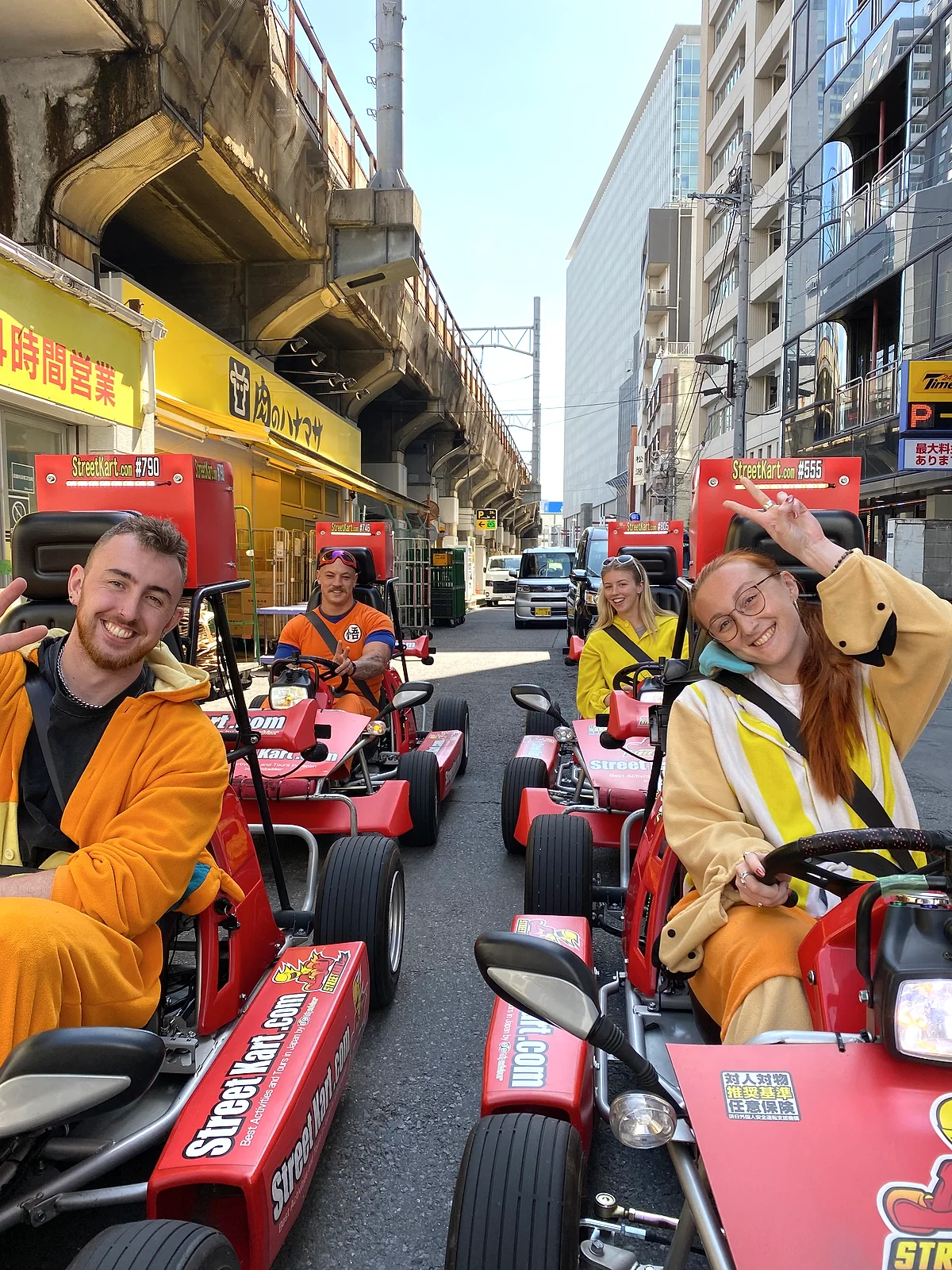
Third, everyone drives their own kart. The karts are single-seaters, so even if you come as two, each of you is at your own wheel. Rather than watching from the passenger seat, you both drive the same roads.
Fourth, there's how it feels while you're riding. On a kart, the city's sounds and the wind feel much closer than when you're walking. The angle at which you look up at buildings is a little different, too. This is where the clothing prep from the previous section pays off.
Fifth, the route connects the area right by Akihabara to the views of Tokyo Station and Ginza: electric town signs, the red-brick station building, the Ginza clock tower. The sights listed for the Akihabara shop's route are streetscapes with completely different personalities.
Sixth, the track record. As of November 2023, across all shops, there had been more than 150,000 tours, more than 1.34 million customers, and more than 20,000 reviews, with an average rating of 4.9 out of 5. These aren't current figures, but they give you a sense of the scale the service has kept running at. There are 9 shops nationwide: 7 in Tokyo, and one each in Osaka and Okinawa.
A Few Small Plans So the Two of You Don't Get Lost
Finally, here's a quick plan for spending a windy day in Akihabara as a pair.
In crowded Akihabara, it's easy to lose each other inside a shop. If you decide on a meeting spot ahead of time, say, in front of the Electric Town exit if you get separated, you won't panic. Phone batteries can drain faster than expected in wind and cold. Having one power bank to share between you is reassuring.
I'd suggest not packing your schedule too tightly. When the wind picks up, go inside. When it dies down, go out. To make that switch easy, keep one building in mind for each time of day, and the weather won't throw you around. A station café in the morning, Yodobashi Camera Akiba at midday, a restaurant in the evening. A rough plan like that is enough.
The quiet electric town in the morning, the fast-moving clouds at midday, the signs lighting up in the evening. On a windy day, Akihabara shows a side you don't see on calm days. Capture those differences in your photos.
If you're adding Street Kart to your plans, start by checking the booking contacts and weather guidance on the official website.
When the wind dies down, head back outside.
This article was originally written in Japanese and translated using AI. Some expressions may read unnaturally, and we appreciate your understanding. For the most accurate and up-to-date information, please refer to the official site at kart.st.
Street Kart is not affiliated with Nintendo or the Mario Kart series in any way. We do not provide costumes of Nintendo characters, and such costumes may not be worn during tours even if brought by participants.