
Joining a Street Kart Tour in Akihabara with Strangers: How Breaking the Ice Changes from Day to Night
Joining a Street Kart Tour in Akihabara with Strangers: How Breaking the Ice Changes from Day to Night
When you step out of the Electric Town Exit at Akihabara Station, the first thing you see is the giant signage of the electronics megastores. The next thing you notice is the crowd. Everyone is walking a little fast, headed somewhere. A short way off from that stream of people, the two of you, traveling as a pair, are about to meet a group of strangers who may end up riding the same tour.
Street Kart runs guided tours. Whether you'll share a session with other participants is something to check on the official website before you book. If you've been picturing time with just the two of you, you might feel a bit wary. But those "strangers" can change the texture of a trip. And how they change it depends a lot on whether you ride during the day or after dark.
This article looks at Street Kart as a gathering where strangers mix, focusing on the difference between time slots. How should you plan your limited time? Where are the moments worth capturing in photos? Both questions are answered based on what you'll actually see.
Lining Up with Strangers
First, a word on how it works. The karts are single-seaters. Even if you come as a pair, each of you drives your own. There's no chatting while gazing at your partner's profile from the passenger seat.
So the person "next to you" while driving isn't your partner. It's whoever is in the kart ahead or behind. You follow the back of the person in front, with someone else trailing behind you. You drive behind the guide, and you wait at the same intersections for the same lights.
In the U.S., it seems many people are comfortable making small talk with strangers right away. In Japan, plenty of people leave a little space between themselves and someone they've just met. Neither is right or wrong. But when people of different nationalities end up in the same session, that difference in comfort levels shows up directly in the mood of the waiting time. Some people will start talking to you immediately; others will just nod. That's perfectly normal.
What works here is a short phrase, not an elaborate self-introduction. "Where are you from?" is enough. If you want to try some Japanese, "Yoroshiku onegaishimasu" is just right. It's hard to translate directly, but it means something like "I'm in your hands for a little while," and it works in any first-meeting situation.
There's one tip specific to traveling as a pair: don't huddle too closely together. When couples or friends are deep in conversation with each other, others can't find a way in. If just one of you turns outward and says something, the circle tends to widen surprisingly easily.
Akihabara by Day: Seeing Faces Makes It Easier to Talk
In a daytime group, you can see people's expressions clearly. Are they smiling? Are they nervous? When you're warming up to strangers, this matters more than you might think.
In daytime Akihabara, the colors of the signs jump right out at you. Along Chuo-dori, signs for electronics stores and hobby shops are stacked vertically, every outline sharp. Conversations that start with pointing and asking, "Did you go to that shop?" during the wait usually happen in the daytime. With so much in view, you won't run out of things to talk about.
The route materials for the Akihabara location list places like the Marunouchi building of Tokyo Station, the streets of Ginza, and Chuo-dori in Akihabara Electric Town. Which places you pass depends on the tour, so if there's a spot you care about, it's safest to confirm when you book. In daylight, you can really see the texture of the red brick of the Marunouchi station building. It opened in 1914, and its restoration was completed in 2012. Looking up at it from a low vantage point, the front facade stretches out wider than you'd expect.
In Ginza, the materials list landmarks such as the Wako clock tower at the 4-chome intersection and the Kabukiza theater building. In the daytime, you can see what's in the shop windows and what the people walking by are wearing. After the ride, you might say to the person ahead or behind you, "The Ginza intersection was packed, wasn't it?" Daytime tours leave you with plenty of conversation starters like that.
Heat and sunlight vary a lot by season. Tokyo summers can get quite hot during the day, so if you choose a daytime session, check the weather forecast for the day. Rules about clothing and weather are posted on the official website.
Making Use of the Time Before Departure
Pairs who choose a daytime session can more easily leave some breathing room before departure. According to the materials, Kanda Myojin Shrine is about a 10-minute walk from the Akihabara location. Regarded as the guardian shrine of old Edo and with a 1,300-year history, it's known for blessings for business prosperity and matchmaking. Not a bad reason for two people to put their hands together in prayer.
Though it's not far from the bustle of Electric Town, the air changes once you step onto the grounds. Pass through the vermilion gate, and the traffic noise seems to retreat one layer away. It's just the right distance for a quick stop before your tour.
If you have more time, Ueno Park is also an option. According to the materials, it's about five minutes from Akihabara by train. It's a large park home to the Tokyo National Museum and the National Museum of Western Art, so if you plan to spend half a day, you could do Ueno in the morning and karting afterward. Just don't be late for the meeting time. Follow the meeting time given in your booking information.
By the way, the store has no parking. Please use public transportation. According to the materials, it's a 5-minute walk from Akihabara Station (JR, Tokyo Metro Hibiya Line, Tsukuba Express), a 3-minute walk from Suehirocho Station on the Tokyo Metro Ginza Line, and a 7-minute walk from Iwamotocho Station on the Toei Shinjuku Line. Enter the station name in English into Google Maps, and it will guide you, including transfers.
Akihabara After Dark: The Glow of the Signs Brings the Group Together
Even at the same clock time, how light it is outside varies greatly by season. Winter gets dark early; summer stays light late. So there's no single answer to "what time should I go for night views." What I'm describing here is what it looks like if you gather after dark. Check the official website (kart.st) for whether night sessions are available and for departure slots.
In a group that gathers after dark, you can't see people's faces as well as during the day. Instead, something else moves the mood: light.
Seen in the daytime, the signs of Electric Town are just colored panels. When it gets dark, they light up from within, and the street takes on a different face. A group of strangers looks up in the same direction, bathed in the same light. Even without exchanging words, a sense of seeing the same thing forms. By day, conversation closes the distance; by night, the scenery does. That may be the closest way to put it.
After the tour is different too. With daytime sessions, people tend to scatter to their next destinations once the ride is over. After dark, the conversation more easily turns to dinner. "I'm hungry, want to go somewhere?" seems to come out more naturally than it does during the day.
According to the materials, Akihabara Ramen Street is about a 5-minute walk from the store, Tonkatsu Marugo is a 10-minute walk away, and Kanda Yabu Soba, a long-established soba restaurant, is a 15-minute walk away. If you're going with people you just met, a place like a ramen shop, where one dish is a whole meal, is easygoing. Many ramen shops in Japan have you buy a meal ticket from a ticket machine first, so if you're unsure, just watch the person ahead of you and copy them. Some places only take cash, so it's reassuring to carry a little.
There's no tipping culture in Japan. If you try to add a tip to the bill the American way, you may actually put the staff in an awkward spot. If your group wants to split the bill, ask "Can we pay separately?" before you check out, so you're not scrambling at the register.
At Night, Ask Before You Take Photos
Let's talk about photos. First, don't hold your phone and shoot while you're driving. Focusing on driving is the best safety measure there is, and it's not a situation where you can take your hands off the wheel. Whether there will be a chance to take photos depends on your guide's instructions on the day.
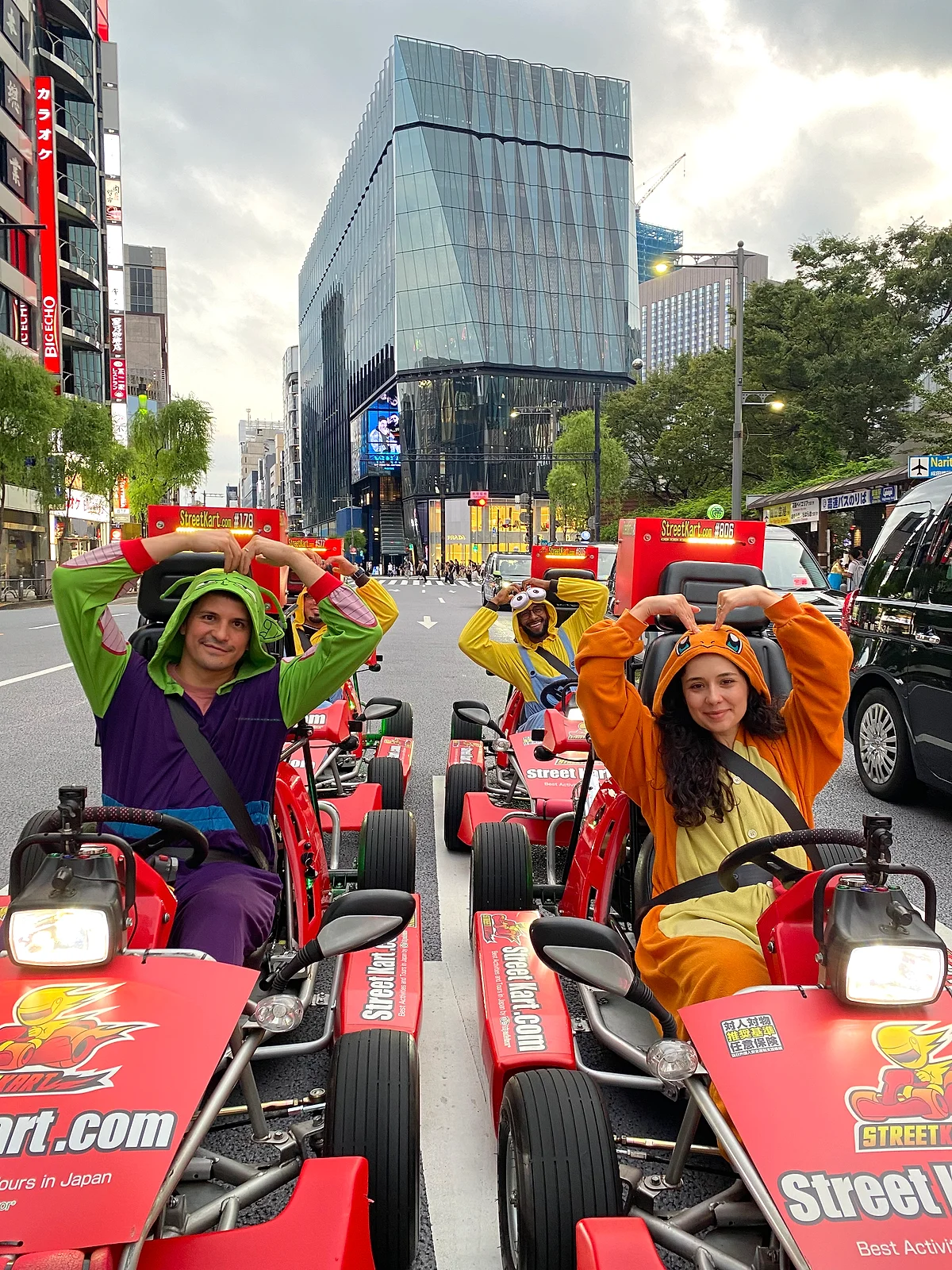
The sure bets are before departure and after the ride. The two of you side by side, with your karts, in one shot. Check with the staff on site whether it's okay to take photos around the store. In the daytime, the kart colors and the streetscape come out crisp. After dark, the glow of the signs fills the background, giving you a shot that's different from daytime. At night the shutter speed gets slower, so hold your phone firmly with both hands and take a breath before shooting to reduce blur.
One thing to be careful about in a group with strangers is other participants appearing in your shots. If you plan to post on social media, all the more reason to ask first. "Shashin, ii desu ka?" ("Is it okay to take a photo?") gets your intention across, whether you say it in Japanese or English. Some people don't want their faces shown. That deserves respect, regardless of nationality.
On the flip side, this can lead to asking a favor. When traveling as a pair, there's no one to take a photo of you two together. Ask someone ahead of or behind you, "Could you take a photo of us?" and take theirs in return. That alone brings you much closer for the rest of the time. It works day or night, but because photos are a bit harder to take in the dark, you end up spending longer showing each other the screens afterward. And that time turns into more conversation.
If you post, adding hashtags like "#Akihabara," "#秋葉原," and "#StreetKart" will help when you look back for your travel memories later.
What Makes Street Kart Appealing for Pairs of Travelers
Here's a rundown of Street Kart's features from the perspective of two people traveling together.
First, the feel of the vehicle itself. Once you're in it, your eye level is closer to the road than you expected. The height of the buildings and the width of the intersections loom at a different scale than when you're walking. The wind hits your face, and the sounds of the city come straight to your ears. That's the kind of ride it is.
Second, it's guided. On Street Kart tours, a trained guide drives at the front, managing the route and keeping an eye on safety. Participants follow behind.
Third, the language of the guidance on the day. Tour-day guidance is basically given in English. Guidance in Japanese or other languages depends on the staff that day, so it can't be guaranteed. If you'd like guidance in a language other than English, try asking in advance through the official website. The website itself supports 22 languages.
Fourth, its track record. As of November 2023, across all locations, the total number of tours exceeded 150,000, total customers exceeded 1.34 million, total reviews exceeded 20,000, and the average rating was 4.9 out of 5.0. These figures are all as of November 2023, so current numbers may differ.
Fifth, the number of locations. Street Kart has nine locations nationwide: seven in Tokyo, one in Osaka, and one in Okinawa. However, the seven Tokyo locations aren't spread across seven areas. The Akihabara 1st and 2nd stores, and the Shibuya and Shibuya Annex stores, are each in roughly the same place. Tokyo also has locations in Shinagawa and Tokyo Bay (Shinkiba), and the scenery along the route differs by location.
Sixth, Akihabara itself. Electric Town, Kanda Myojin, Ueno, Tokyo Station, Ginza. Places you can visit before or after your tour are clustered within walking or train distance. According to the materials, Tokyo Station is about five minutes away by train and Ginza about ten. For pairs with only a few days in town, it's worth lining up karting and other sightseeing on the same day.
Things to Check Before Booking
A driver's license is an essential requirement for driving on public roads in Japan. Which licenses are accepted differs by country and type. For details, including required documents, please check the official website. If you discover right before your trip that you're not fully prepared, there's almost nothing you can do. Make sure to check before you leave.
Bookings are accepted via Facebook, LINE, and email (booking@streetkart.com). Weekends tend to fill up, so booking early is recommended. If your stay includes weekdays, it might be worth considering those as well.
Duration and departure slots vary depending on the plan and the conditions on the day. Check on the official website before booking whether you'll share a session with other participants. Whether you want to ride in the daytime or after dark, start by checking the official website to see what slots are available for that time of year.
Things That Help If You Decide Them Together
Finally, a few small arrangements to help the two of you enjoy a tour with strangers.
First, decide which of you will be the one to start conversations. If you're both shy, that's fine. But just agreeing that "one of us will try saying something during the wait" can noticeably change the atmosphere on the day.
Second, how to choose your time slot. If you want to bond through conversation, choose a daylight slot, when faces are easy to see and there's plenty to talk about. If you'd rather share the scenery and drift straight into dinner, go for a session after dark. Both have their merits, and since the time it gets dark varies by season, think it over against your travel schedule.
Third, leave a little open time after the tour. In the daytime, you can head over to Kanda Myojin or Ueno; at night, you might end up having a bowl at Akihabara Ramen Street with someone from your session. If you pack your schedule too tightly, you'll have to cut short a conversation that's only just begun.
A few strangers join the trip the two of you came on, just a little. Whether you see that as an extra or as part of your travel memories is up to you.
Under the signs, start with "Where are you from?"
You can check availability and plan details on the Street Kart official website.
This article was originally written in Japanese and translated using AI. Some expressions may read unnaturally, and we appreciate your understanding. For the most accurate and up-to-date information, please refer to the official site at kart.st.
Street Kart is not affiliated with Nintendo or the Mario Kart series in any way. We do not provide costumes of Nintendo characters, and such costumes may not be worn during tours even if brought by participants.