
When Your Plans Fall Apart in Akihabara: How to Recover Before and After Your Street Kart Tour, Morning, Midday, or Evening
When Your Plans Fall Apart in Akihabara: How to Recover Before and After Your Street Kart Tour, Morning, Midday, or Evening
You open the hotel curtains in the morning and it's raining. The train you were supposed to catch isn't running. Travel plans fall apart far more easily than we expect.
Often more than one thing goes wrong. You didn't sleep enough and your legs feel heavy. The shop you were looking forward to has a "temporarily closed" sign on the door. And on top of that, you have a Street Kart booking in Akihabara. Before you panic, stop and check what part of the day you're in. Is it morning, midday, or evening? Your options depend on the answer.
When plans change, first "contact" and "confirm"
First, one basic point. Street Kart is a guided tour, and each location has set routes. You can't just change where you're going on a whim. So on the day, the question isn't "where will we drive?" It's only this: "Can everyone in our group be standing in front of the shop at the time we booked?"
Maybe you're running late, maybe you can't make it, or maybe the weather looks bad. Whatever the reason, contact the channel you booked through as soon as you know. Bookings and inquiries are handled through Facebook, LINE, and email, and the contact details are on the official website. The same goes for cancellations and rainy-day policies. The official site's latest information is more reliable than old posts on social media.
This is where you get a feel for how things work in Japan. Here, letting people know ahead of time usually makes everything go more smoothly. Telling someone you'll be late isn't rude. It's seen as helping them plan. Put the awkwardness aside and send the message.
The day of the week matters too. Weekends book up quickly. If you decide on a Saturday that you'd rather move to the evening, there may be no spots left. Don't assume either way whether you can reschedule. Ask. Also, tour guidance on the day is generally in English. Guidance in other languages depends on the staff working that day and isn't guaranteed. If this concerns you, contact the channels listed on the official site. The website is available in 22 languages, but that refers to the site's display languages, not the guidance on tour day. Check the rules and required documents on the site before you head out. Akihabara also has two locations, Store 1 and Store 2, which are very close to each other. On the day, look again at the store name in your booking confirmation.
If plans fall apart in the morning, you still have plenty of options
If things go wrong in the morning, you're actually fairly lucky. You still have time before the tour, so there's lots of room to rework your day.
Don't try to go far to make up for lost time. "If we head to the place we planned for first thing this morning, we can still make it." Go with that thinking and you'll probably spend the whole trip back staring at the clock. If your morning is free, it's more relaxing to spend it near the shop.
About a 10-minute walk from the Akihabara location is Kanda Myojin, a shrine with 1,300 years of history, regarded as the guardian shrine of old Edo. It's just a few minutes' walk from the signs and shouting touts of Electric Town, but the feel of the air changes. A photo taken in the shrine grounds in the morning adds a "quiet beginning" to your day's record. As a first photo on a day that fell apart, that's not bad.
Kanda Myojin is also known for blessings for business success and for finding love. On a morning when your plans have fallen apart, you could stop here and say a prayer for the rest of the day.
If you just need to sit down and regroup, Starbucks Akihabara Ekimae is about a 2-minute walk from the shop, and Veloce is about 3 minutes away. Put a coffee in front of you and look up train status and your remaining time before the tour on your phone. After a morning like that, just doing this clears your head a lot.
Opening times in Electric Town vary from shop to shop. Yodobashi Camera Akihabara is close, about a 3-minute walk from the shop, but if you plan to stop by in the morning, check the opening time on Google Maps first. Standing in front of a closed shutter with no one else around is common enough when traveling.
On a rainy morning when you don't want to walk around outside, have some indoor spots in mind. Akihabara has shops like Animate Akihabara, Mandarake, and Super Potato, which sells retro games, and just browsing the shelves passes the time. But again, opening times differ by shop. And the more absorbing the place, the easier it is to forget the tour time. Setting a phone alarm before you go in is a good idea.
There's one more thing to take care of in the morning: checking the documents you need to drive. What's required depends on your country and the type of license you have, so check on the official website for each person in your group. If you realize you forgot something after leaving the hotel, the time spent going back for it is simply gone.
One thing that's easy to miss: the karts are single-seaters. Passengers aren't allowed, so everyone who joins will be driving. Check each person's eligibility requirements on the official site as well.
On a rainy morning, don't decide to cancel on your own. First ask the booking channel whether the tour will go ahead and whether you can change it.
It's also worth reconsidering your outfit in the morning. The official guidance recommends closed-toe shoes (sneakers if possible) and clothes that are easy to move in, and says to avoid open-toe shoes, heels, skirts, and dresses. If you have a reservation at a nice restaurant that night and dressed for it from the morning, decide where you'll change before the tour so you're not scrambling.
If your tour is on checkout day, think about your luggage too. The lockers at the shop are meant for small items and aren't suitable for large luggage like suitcases. Decide ahead of time what to do with large bags, including whether your hotel can hold them, and the day will go more smoothly. If you're not sure how to handle it, contact the booking channel.
If plans fall apart at midday, stay within easy reach
Sometimes things fall apart around noon. There's a long line at the lunch spot. Your afternoon plans suddenly fall through. Your tour is in the late afternoon. Your task at midday is figuring out what to do with that awkward stretch of free time.
One rule is enough: stay close enough that you can easily get back. As a rough guide, Ueno Park is about 5 minutes from Akihabara by train, Tokyo Station is also about 5 minutes, and Ginza is about 10 minutes. From the numbers alone, it looks like you can go anywhere. But add walking time from the station and transfers, and the round trip takes longer than you'd think.
Tokyo Station and Ginza deserve a bit of thought. Some tours from the Akihabara location pass the Marunouchi Building of Tokyo Station and Ginza. If you've booked one of those courses and go there before the tour, you'll likely end up seeing the same sights twice. For free time before the tour, choose somewhere in a different direction, like Ueno Park. That way the parts of your day don't overlap.
Ueno Park is home to Ueno Zoo, the Tokyo National Museum, and the National Museum of Western Art. You could spend hours at any of them. If you go, pick just one. Decide "just the zoo today" or "just the museum today," and set your departure time in advance. That's what staying within easy reach means.
On the other hand, going back to Tokyo Station after the tour is a good idea. On a kart, your attention naturally stays on the road ahead. The red-brick Marunouchi Building opened in 1914, and its restoration was completed in 2012. If you want to photograph the main facade from the Marunouchi side, it's better to walk there and take your time. A photo taken while thinking "we drove right past this earlier" becomes a real photo from that day's trip.
In case of train delays, get to know the stations around the shop as well. Akihabara Station is about a 5-minute walk from Store 1 and about 7 minutes from Store 2, and is served by JR, the Tokyo Metro Hibiya Line, and the Tsukuba Express. Suehirocho Station on the Tokyo Metro Ginza Line is about a 3-minute walk, and Iwamotocho Station on the Toei Shinjuku Line is about 7 minutes. If one line stops, you may still be able to get close on another. If you ask station staff, "Suehirocho wa doko desu ka?" ("Where is Suehirocho?") will get you understood.
Don't come by car. The shop has no parking. The more your schedule is running behind, the more sense public transportation makes.
If plans fall apart in the evening, rework them with sunset in mind
Changes in the evening push you to decide quickly, since there's less time left. Sunset times also change a lot with the seasons. In autumn, the days get shorter every day. You may look up at the sky and think, "It was still light at this time yesterday."
When heading to an evening tour, keep in mind that arriving right at the start time isn't enough. On the day, staff check your driver's license and other documents at reception, and you get a safety briefing and an explanation of how to operate the kart and the route before you set off. Check your booking confirmation or the official site for how early you should arrive. If you make a stop on the way, work backward from that arrival time and leave in time.
What if the dinner you planned after the tour falls through, or you can't get into the restaurant you booked? In that case, looking for food near the shop is the practical choice. Akihabara Ramen Street is about a 5-minute walk from the shop, Tonkatsu Marugo is about 10 minutes, and Kanda Yabusoba, a long-established soba restaurant, is about 15 minutes. Closing times and closing days vary, so check a map app before heading out.
If you want to go a little further, Ginza is about 10 minutes by train. If you took a course that passes through Ginza, you'll now be walking the streets you drove through on the tour. At the Ginza 4-chome intersection, where the Wako clock tower stands, and along Chuo-dori lined with department stores, the outlines of the buildings look sharper at night. The streets you raced through during the day look a little different when you walk them at night. Kabukiza, Ginza Mitsukoshi, and Matsuya Ginza are also in this area, so you can use them as landmarks for a night walk.
If you stay in Akihabara, try photographing the Electric Town signs along Chuo-dori. After dark, the light from the signs spills onto the sidewalk, and your photos come out in different colors than during the day. Move to a spot where you won't block foot traffic before you raise your camera. Stand at the edge of the street, with the signs behind you, and shoot at a slight upward angle. That makes it easier to keep passersby out of the frame.
Why people choose Street Kart
Here are a few things that stand out more on a day when your plans have fallen apart.
First, you don't have to plan the route yourselves. A trained guide drives in front and leads you along a set route. On a day when plans keep shifting, even making decisions gets tiring. While you're driving, you don't have to think about where to go. On a day that fell apart, time spent focused on the road and the scenery in front of you feels like a small relief.
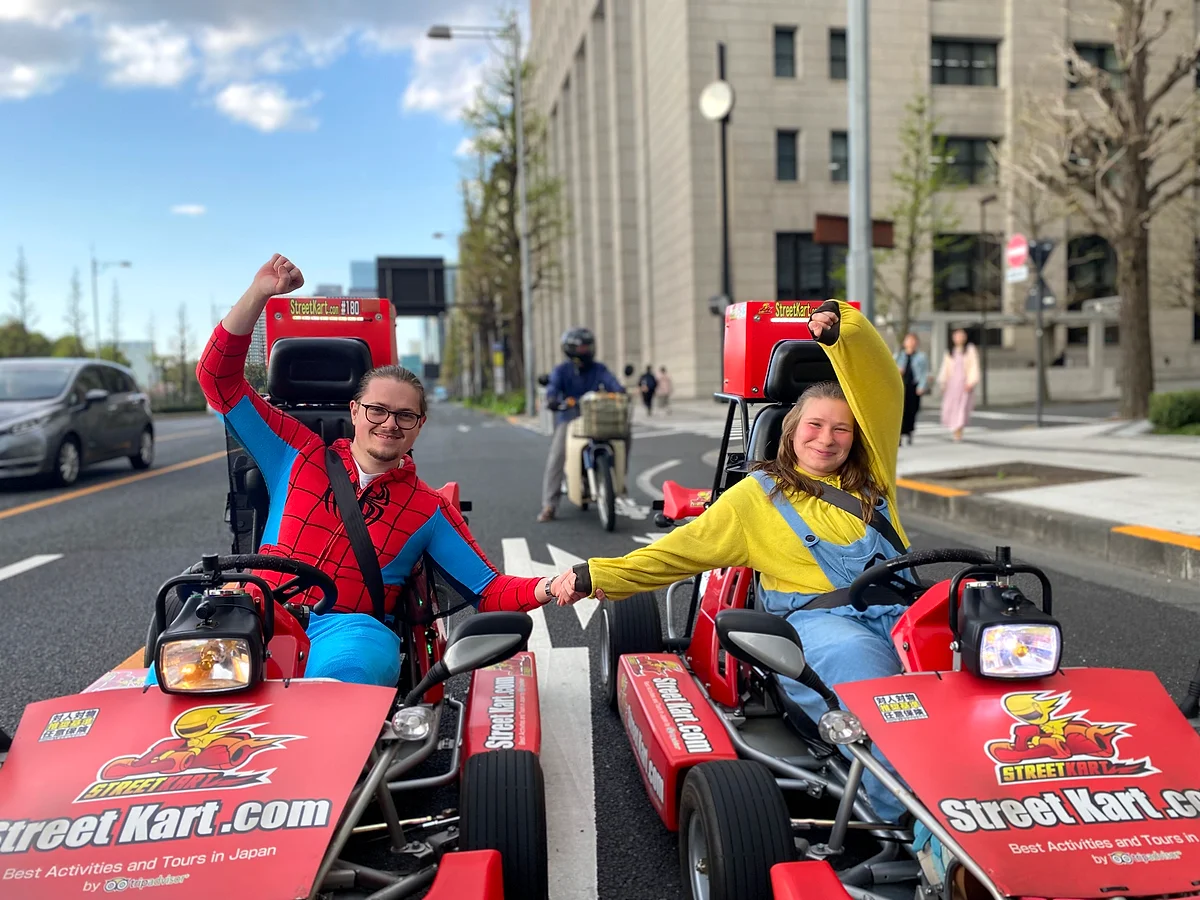
Second, you see one classic Tokyo sight after another in a single tour. Depending on the course, you pass through Akihabara's Electric Town, the Marunouchi Building of Tokyo Station, and Chuo-dori in Ginza. Even if your morning plans fell through and you lost sightseeing time, you can pass these places in one continuous trip. On a kart, you take in the height of the buildings, the sounds of the city, and the wind with your whole body.
Small agreements that make the day easier for two travelers
When plans fall apart, what couples and pairs tend to argue about is "who does what." If both of you are looking up transfers on the same screen, contacting the tour gets pushed back. So agree on roles before you head out. One person handles contacting the booking channel, and the other checks train status and how to get there. That alone makes a big difference in how quickly you get moving.
Both of you should keep a screenshot of the booking confirmation. Even if one phone's battery dies, you can still show the store name and booking details right away.
The karts are single-seaters, so both of you will be driving. The usual travel habit of "one drives, the other rides in the passenger seat" doesn't work here.
Finally, here's a summary of what to do at each time of day. If things fall apart in the morning, regroup nearby and check your documents. If they fall apart at midday, stay close enough to get back. If they fall apart in the evening, rework your plans with sunset in mind, either near the shop or in Ginza. Assume the tour time itself won't move, and ask the booking channel whether it can. Remember this order and you won't need to panic.
If you're still choosing your dates, weekends book up quickly, so we recommend reserving early.
Leave a little room in your schedule. With that room, even if something falls apart, your day in Akihabara can still get back on track.
This article was originally written in Japanese and translated using AI. Some expressions may read unnaturally, and we appreciate your understanding. For the most accurate and up-to-date information, please refer to the official site at kart.st.
Street Kart is not affiliated with Nintendo or the Mario Kart series in any way. We do not provide costumes of Nintendo characters, and such costumes may not be worn during tours even if brought by participants.